
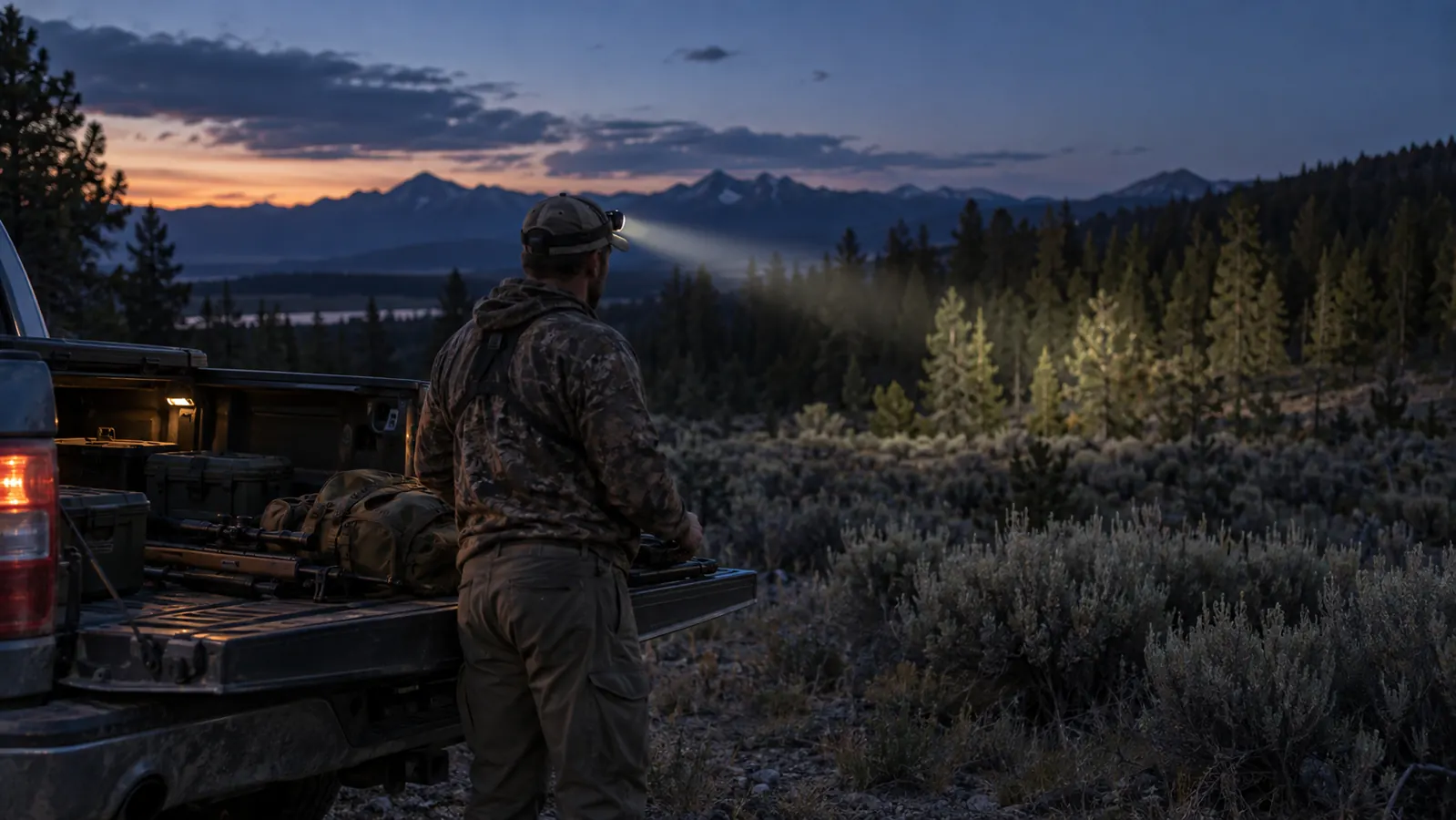
Back in April I got tired of doing one-handed work in the dark. Setting up camp, tying a fly, finding the zipper on a pack, all of it needs two hands, and a flashlight only gives you one. A buddy on an elk forum kept going on about the LHKNL headlamp, and with over 36,000 ratings and a 4.5 average on Amazon, I figured it had enough eyes on it that it could not be a total dud. I ordered one and made myself a rule: no judgment until it had been through a real season with me.
Six months later, it has been in elk country for September and October, on the Weber for trout, on Willard Bay for bass, and loose in the bed of my Tundra for most of the summer. It has been rained on, bounced on gravel, and left in a hot truck for a week at a time. The only thing I have not done is drop it off a cliff, and I have come close. If you are in the market for a rechargeable headlamp, this is what a long test looks like.
The Quick Verdict
For a rechargeable headlamp at this price, it earned a permanent place in my pack. Not the sharpest or the lightest, but dependable where it counts. Two real gripes cost it the last point and a half.
Amazon Check Today's Price →The light I grab when the day runs short
Six months of hunting and fishing trips, and this headlamp has not let me down once. Check today's price on Amazon and read what 36,000 other buyers have to say before you decide.
Amazon Check Today's Price on Amazon →How I've Used It
Archery elk opened on a Saturday this year, and I was on the mountain at 4:30 that morning. I wore the headlamp on low for the walk in, which is enough to see the trail but not enough to wreck your night vision or spook the deer and elk bedded near the drainage. That has been the pattern all six months. It is a camp-and-trail light first, and I kept expecting it to let me down. So far it has not.
The middle setting does the work around camp. Cooking, digging through a bag, tying a tippet in the wind on the Ogden, re-rigging a bass rod at Willard when the light is going, it all happens with the lamp on my head and both hands free. That is the whole point of a headlamp, and this one never got in my way. The strap sits flat over a ball cap or a knit cap without slipping, and the housing tilts down far enough to light a workbench or a gut pile without craning my neck.
I charged it the same way I charge my phone: a USB cable in the truck or on the counter. One charge got me through a full weekend of fishing, and on a seven-day elk hunt I charged it twice, once at the trailhead and once in camp off a small power bank. I never once worried about it dying on me, which is about the highest compliment a rechargeable light can get.
Old habits die hard, so the headlamp has also spent plenty of evenings at my workbench in the garage. I spent twenty-two years as a heavy equipment mechanic, and some things stick with you. When I need to see into an engine bay or trace a wire after dark, this is the light I reach for. The tilt hinge is the reason. It lets me aim the beam down at the work instead of straight ahead, which is something the cheap clip-on lights I used to buy never got right.
The Beam, and What It Won't Do
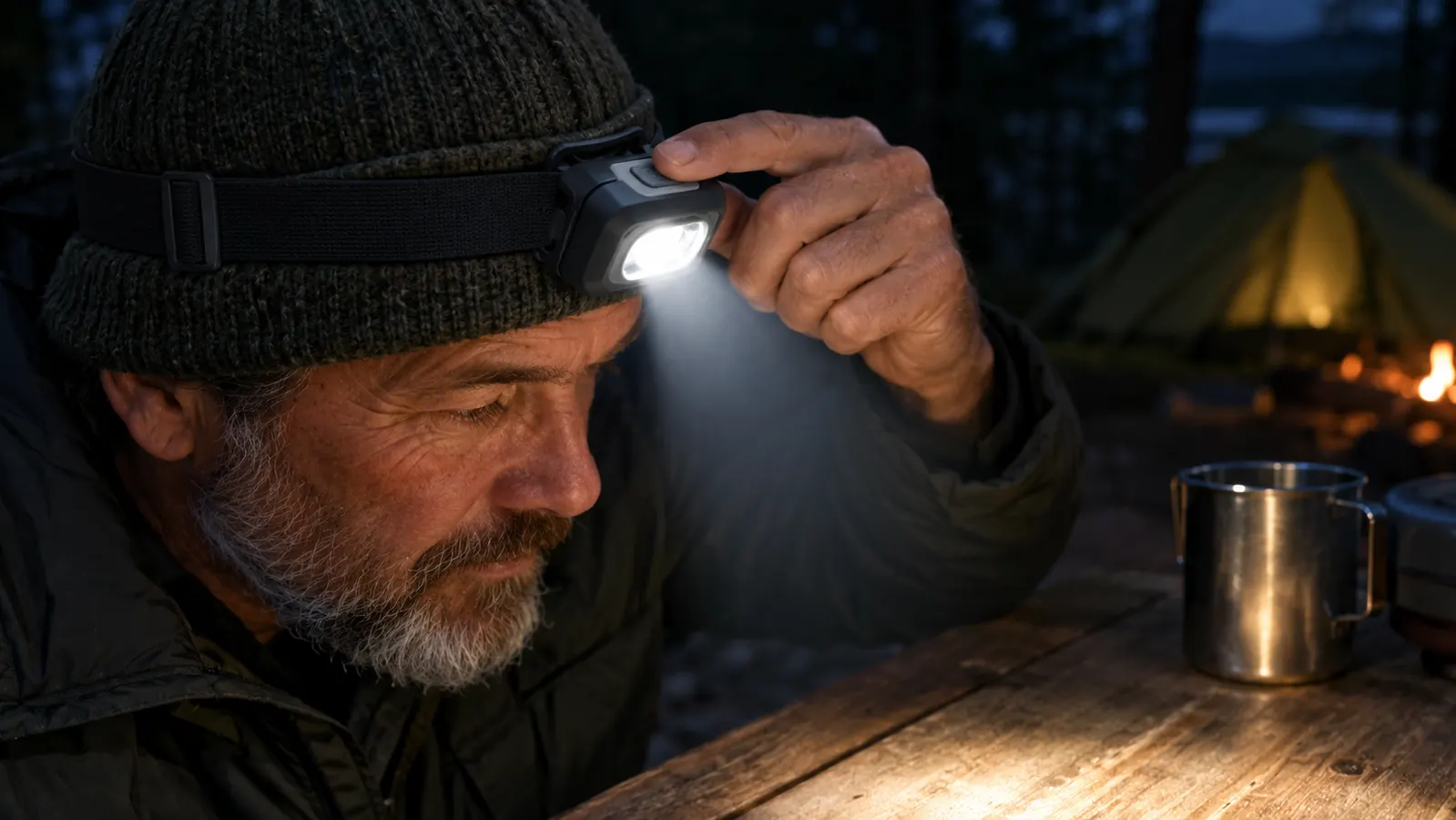
Here is where I have to be straight with you. The headlamp is bright, and the word bright in the product name is doing a lot of work, but it is a working light, not a spotlight. It throws a wide, even pool of light that is perfect for camp chores, walking a trail, and seeing what is in front of your boots. If you need to light a ridgeline two hundred yards away to count elk at dusk, this is not that tool. I bring a small handheld spotlight for that.
The settings make sense. Low is for the tent and for moving at night without giving yourself away. Medium covers most camp work. High is for when you need to see a lot of ground at once, and it is genuinely bright at the cost of battery life. Clicking through the modes takes a second or two, and once in a while with heavy gloves I click past the one I want. That is a small price, and I have learned the rhythm of the button.
I will not quote you lumen numbers. The numbers on a listing are often written by someone in marketing who has never stood on a riverbank in the dark. What I can tell you is what I saw with my own eyes: on low, the LHKNL lets me move through the trees without lighting up the whole hillside. On high, it is bright enough to find a dropped knife in the grass at the edge of camp. The truth is in there somewhere between those two, and that is where I live.
Battery, Charging, and Cold Weather
The battery has not shown any drop-off in six months, and I have maybe fifty charge cycles on it. Lithium cells degrade, and cheap lights sometimes lose half their runtime in the first year. This one still runs as long now as it did in April, which tells me the charging circuit is doing its job. It charges through a USB port, and a full charge from dead takes about the same time as my phone.
Cold is the real test for any rechargeable light, and I have only started to see it. My last January at Pineview, ice fishing, taught me to keep any headlamp battery warm in an inside pocket until I need it. Cold saps charge fast. I expect this light will need the same care when the hard winter hits, and I will keep it in my coat, not in the truck, when the temperature drops below freezing.
I should say something about the charging flap, because it is the kind of detail that tells you how a light was engineered. The little rubber cover over the port has been opened and closed maybe a hundred times in six months, and it still seats tight. On more than one cheap light I have owned, that flap tore off in the first month and let dust into the port. Six months in, there is not a speck inside this one.
Gravel, Rain, and Truck Beds
Durability is where cheap gear usually shows its hand. I have dropped this headlamp on gravel once, when it slid off the hood of the Tundra. It landed lens down, and there is a scuff on the rim of the plastic you can see if you look close. The lens itself did not crack and the light kept working. It has also been rained on hard, twice on the Weber and once in a surprise storm on the bass boat, and it never flickered. I would still not go swimming with it, but I no longer worry about weather.
The strap is the part I expected to fail first. Elastic stretches, glue lets go, and you end up with a light too loose on your head. Six months of sweat, rain, and sun have not done it in. It still holds snug over a bare head and over a cap. The little ridges on the strap do what they are supposed to do and keep it from sliding around when I bend over to pick something up off the ground.
Dust has been part of the test too. Late summer makes dust out of Utah trails, and that dust gets into everything. I have had lights develop a flicker after one dusty week in the mountains. The switch on this one still clicks clean, the beam is clear, and I have not once had to slap it to get it going. For gear that lives loose in a truck bed, that is the record that matters.
Two Gripes After Six Months
First, there is no battery gauge. You get a light that runs fine, and then you get a light that is noticeably dimmer, and then you get nothing. There is no warning light and no way to check the charge without plugging it in. That is the one thing I genuinely wish it had, because a dead light on a cold ridge at 5 a.m. is not a fun mistake.
Second, the button is small. With bare fingers it is fine. With the kind of thick gloves you wear in October elk camp, I have to slow down and feel for it. If I had one request, it would be a bigger switch that I can work by feel. Those two things would take this from a very good headlamp to a great one, and they are the only reasons it does not get a perfect mark from me.
One more small thing: on warm evenings the strap against bare skin gets sweaty. At Willard Bay in August, I kept pushing the lamp up off my forehead between casts to let the air in. It is a small thing, and wearing the headlamp over a hat fixes it, but you should know it if you mostly go light in summer.
The test is not how a headlamp looks on your kitchen counter. The test is 4:30 in the morning, day three of a hunt, rain coming down, and the light still comes on when you hit the switch. This one has not missed once in six months.
What I Compare It To
Before I bought the LHKNL, I spent a long time looking at a Petzl headlamp. Petzl has the reputation, and the price to match. But I did not want to run a light on AAA batteries again, and the rechargeable Petzl version costs well more than this one. I have friends who swear by Petzl, and I understand why. On a long hunt, when you are miles from an outlet, a light that takes batteries you can buy at any gas station is a real advantage.
I also kept an old gas station headlamp as a spare, the kind that eats AAA batteries and puts out a flat, weak beam. It stays in the glove box for emergencies. The LHKNL lives in my pack. That difference, between the light you grab when you actually need to see and the light you hope you never need, is where the money goes, and I think it was spent in the right place.
There are a lot of no-name headlamps on Amazon priced well under this LHKNL, and over the years I have bought my share of them. The pattern is always the same. First the hinge gets loose, then the switch gets finicky, then the battery starts dying halfway through a trip. This one has not followed that pattern. If the extra money buys you a light that is still working next year, it is not extra money, it is cheap insurance.
What I Liked
- Rechargeable through a standard USB port, no batteries to buy
- Wide, even beam that suits camp and trail work
- Strap and hinge have held up through six months of hard use
- Low setting is genuinely low, good for moving at night
- Solid value for what it costs
Where It Falls Short
- No battery gauge; it just dims and then dies
- Small button is hard to work with thick gloves
- Beam is a flood, not a long thrower
- No way to run it on disposable batteries when you are far from power
Who This Is For
Buy this headlamp if you are like me: a weekend hunter and fisherman who wants one dependable light that charges in the truck and lives in the pack. It suits camp chores, early walks to the stand, tying flies after dark, and finding your way back to the boat. It is not the light for a professional guide who runs a light eight hours a night, every night. It is for the rest of us, and it fits that job well.
Who Should Skip It
Skip it if you expect to be days from any power source, because no rechargeable light is the right answer there. Skip it if you mostly need to light things far away, because this throws a wide beam, not a long one. And if you already own a headlamp that does what you need, there is no reason to replace it just because a new one has more ratings. Gear does not wear out from sitting in your drawer.
The Bottom Line After Six Months
I do not hand out five-star grades easily, and this headlamp is not a five-star light. But it is a four-and-a-half-star light that costs a fraction of what the big-name brands want for the same job. After six months, it has earned its spot on the shelf next to my keys. I grab it every time I head out the door, and I expect it will still be there next season.
The headlamp I reach for when the days get short
Six months in, I have no plans to replace it. If you want a light that can take the same abuse, check today's price on Amazon and see the full rating history for yourself.
Amazon Check Today's Price on Amazon →