

It was late September, and I had a mule deer at 388 yards. The rangefinder I was carrying would only read to 300, so I spent a long minute walking closer through scrub oak, trying to close the gap without spooking him. He caught my movement and was gone. That night I ordered the TIDEWE rangefinder, the model that reads to 700 or 1000 yards, and I have carried it on every hunt and fishing trip since.
Six months and a full season later, that TIDEWE has been rained on in October, dropped on rocks in November, frozen in the truck bed overnight at 14 degrees in January, and knocked around the center console of my 2016 Tundra for another season of trout on the Weber in April. It still turns on, still reads fast, and the glass is as clear as the day it arrived. That matters to me more than the claimed yards on the box. A rangefinder that works when you need it, after being treated the way field gear gets treated, is worth the money.
The Quick Verdict
Fast readings, clear glass, and a battery that lasts through a season. The mode button takes getting used to, and the case is tighter than it needs to be. For the money, it is the best field tool I have used.
Amazon Check Today's Price →The rangefinder that finally stayed in my pack
After six months and a full hunting season, the TIDEWE Rangefinder is the tool I trust when the shot matters. Fast readings, clear glass, no fiddling with batteries in the dark. If you are replacing an old rangefinder, this is the one to compare everything else against.
Amazon Check Today's Price on Amazon →How I've Used It
My routine does not change much. Archery elk in September, rifle deer in October, ice fishing at Pineview in January, then trout on the Weber and Ogden from April until the water gets too low. Ruby, my chocolate Lab, comes on the fishing trips but never on the hunts. She is too loud in a blind. So the rangefinder gets split duty: some days it is hanging around my neck on a mountain, other days it sits in the boat with a wet dog and a stringer of trout.
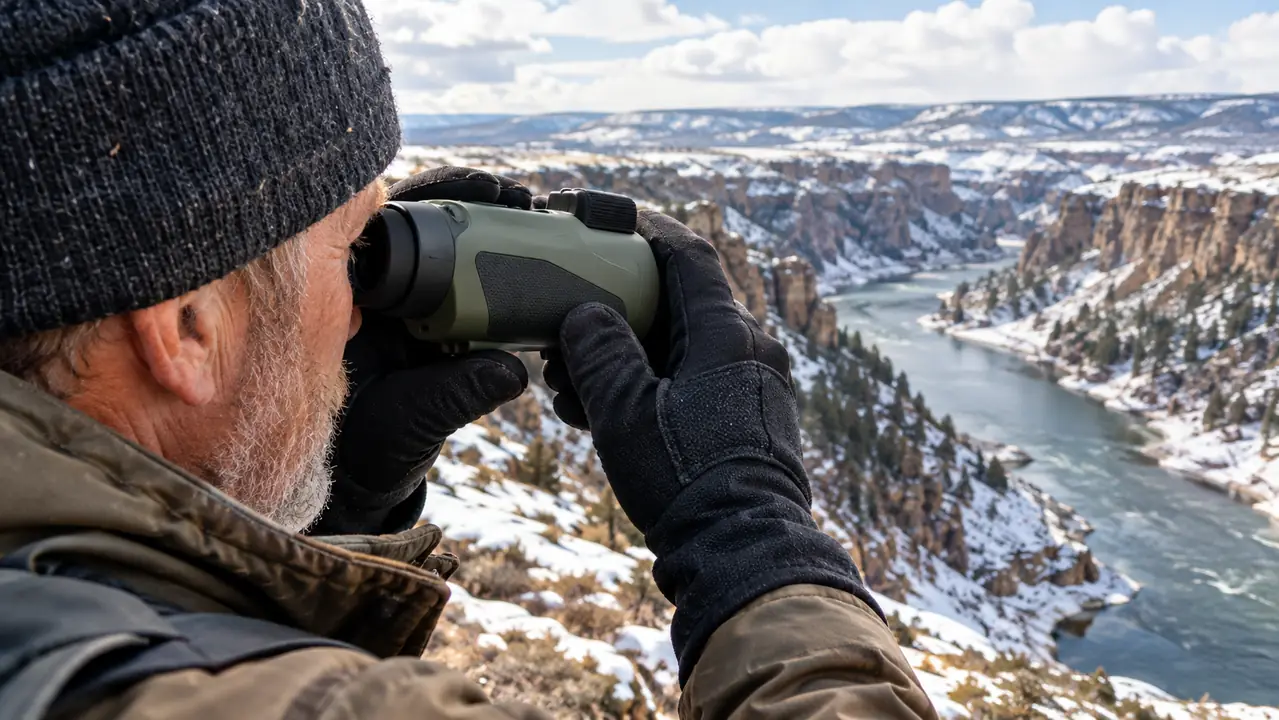
Most of the deer and elk I actually shoot move between 220 and 380 yards, but I range targets beyond that all the time. From a ridge you need to know whether that next canyon is 400 yards across or 500, because it changes how you plan a stalk. The TIDEWE handles that. On a calm morning in late October I set my pack on a rock and ranged the same boulder twenty times from the same spot. Readings never left a four yard band, 391 to 395. That kind of consistency lets me trust the number and keep my eye on the animal instead of watching the display.
On the water it earns its keep too. When I bank fish for bass at Willard Bay, I range a weed line out in the water and know exactly where my cast has to land. The scan mode is what I use most. You hold the button and sweep the far bank. The numbers roll as you go. The moment you cross a dark stump or a deer in cover, the reading jumps, and you know you have found something worth a second look.
Early on I also spent two evenings teaching myself the hold behavior. With a rangefinder you have to learn to hold steady while you press the button. On a cold morning my hands shake more than they used to. The TIDEWE has a half press for continuous scan and a full press for a single reading. I practiced on fence posts in the pasture behind the house until I could get a clean number in under two seconds. That is the kind of practice no spec sheet will tell you to do, but it is worth doing with any rangefinder.
Range and Accuracy
The model I bought is the 1000 yard version. I do not pretend I can shoot effectively at 1000 yards, but I do glass across canyons where knowing the distance to a rock slide helps me plan an approach. On reflective targets like a steel plate or a white rock face, I have gotten solid readings past 800. On an animal, fur is not reflective, so your useful range drops. In my experience a deer sized target will usually give you a clean number out to about 600 yards. That is far past my ethical shooting range, which makes the unit more capable than I am.
More important than the long numbers is how it handles brush. A rangefinder that locks onto a branch between you and the animal is worse than having no rangefinder. I have had that happen with cheaper units. The TIDEWE in scan mode updates fast enough that the numbers move as you swing across a hillside. When a branch cuts across the beam, the reading either drops out or jumps. That tells me the target is not clean. One morning a buck stood behind a single aspen limb. The rangefinder read the limb at 71 yards when aimed at the tree, then jumped to 334 the second the animal stepped clear. I knew the difference before I ever brought the rifle up.
Low light is where I have been let down by rangefinders before. At last light the display can wash out or the reticle can disappear. Here, the red display has a brightness setting, and I keep it one step above the dimmest. It stays visible against a dark timber edge without glowing so bright that it draws an animal's eye. In snow glare I can still find the numbers.
I also tested it against a GPS unit once. I set a waypoint on a fence post, walked 300 yards, and took a reading back to the post. The GPS said 403 yards and the rangefinder said 406. A three yard difference at that distance does not change how you hold. I have not found a reason to doubt the numbers since.
Battery and Recharging
This was the main reason I moved away from my old rangefinder, which ate coin cells. The TIDEWE charges with a USB-C cable. I bought it in late September and charged it five times by the end of March. That includes one night when I left it on by accident. On an average weekend hunt I run it for three or four full days without thinking about the battery.
Cold weather is the usual worry. I left it in the truck bed overnight once when the thermometer read 14 degrees. In the morning it still turned right on, and the battery meter had dropped maybe one bar. On the ice at Pineview I kept it in an inside pocket because my hands got cold, not because the unit needed it.
Would I rather have a unit that takes a CR2 battery that I can buy at any gas station? There are days I think yes, mostly when I forget to plug it in. But I keep the USB cable in my truck console along with the cable for my headlamp, so it has become part of the routine. If you plan to be out for two weeks without power, bring a small battery bank. Problem solved.
I also learned to check the charge before I leave the house, same as my headlamp. The battery meter is a simple icon and it is not perfectly linear, but it is honest enough. When the icon shows one bar left, I charge it. I have never had it die partway through a day. I did have it drop from two bars to one in cold weather, but it kept reading. Carry the cable, charge when the icon drops, and you will not be caught.
Controls and Display
The controls are about as simple as they come. One button on top turns it on and takes a reading. A second button cycles through yards, meters, and scan mode. My biggest complaint is that the two buttons sit close together. With heavy gloves on, I have more than once hit the mode button when I meant to hit the power button, and then spent a few seconds cycling back to yards. It never cost me a shot, but it cost me patience, especially the first month.
The display itself is a red OLED. I like red on black because it does not wash out in the last minutes of shooting light. The numbers are thick and clear, and at my age, without reading glasses, I can still read them. That is not true of every rangefinder I have owned. The eye cup is rubber, and it blocks most stray light. I wear glasses, so I press the cup against my glasses and get a full view. Not perfect with glasses, but workable.
Build Quality in the Field
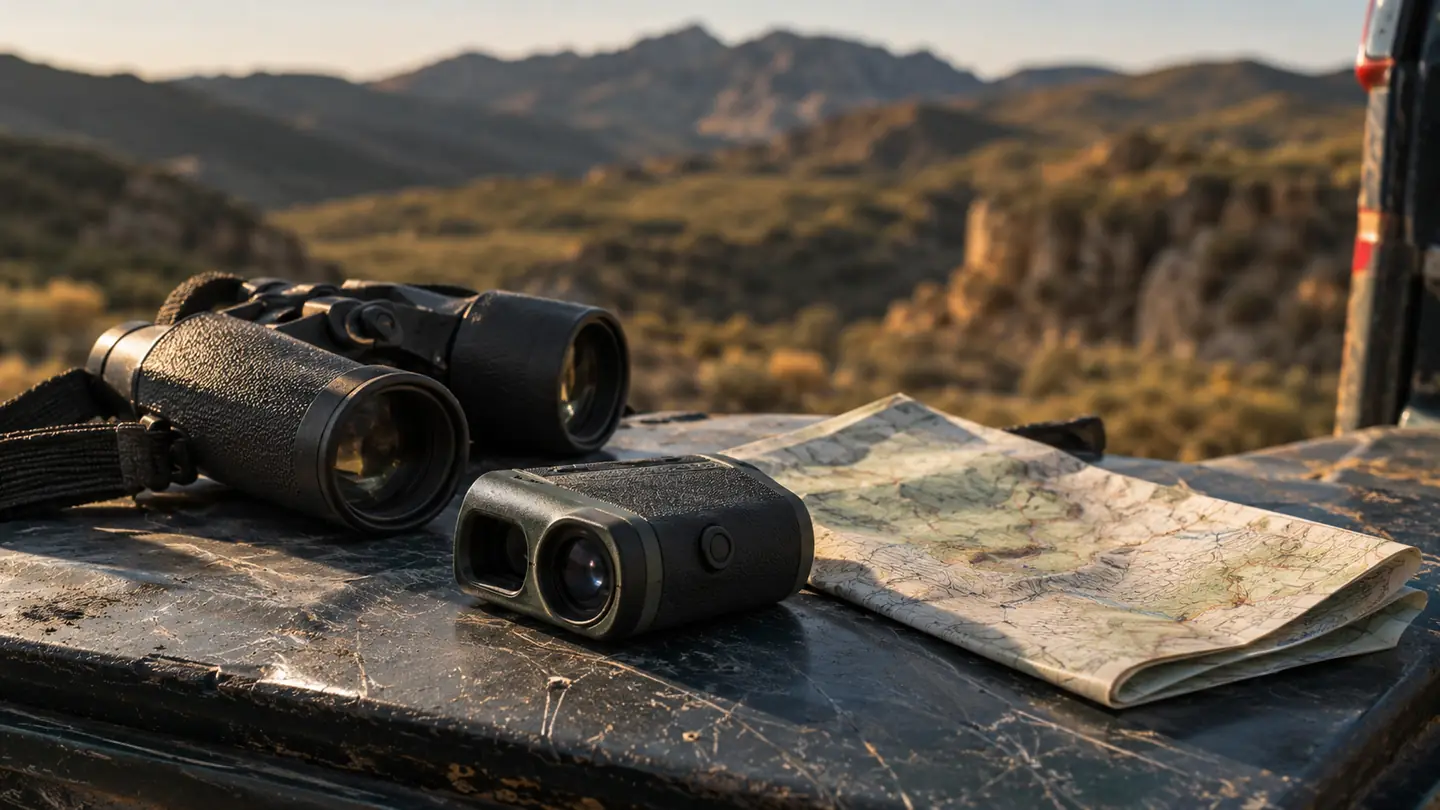
I have dropped this thing four times. Once onto talus above 8,000 feet, once onto the frozen boat ramp at Willard Bay, and twice onto the floor of my truck while I was digging for a bottle of water. It has scuffs on the corners and a small ding on the objective housing, but it still works perfectly. The rubber armor has held up with no tears, and the glass has not picked up a scratch. That is the kind of abuse a rangefinder has to survive to earn a permanent spot in my Tundra.
I do not want to oversell the water resistance. The specs do not call it waterproof, and I have not treated it like it is. It has been rained on and snowed on without fogging, and the lens coating sheds water well. But if a downpour catches you in open country, do what I do: tuck it inside your coat. It is field durable, not a dive tool.
The stock case is the weakest part of the package. The zipper is stiff, and the belt loop will not fit any of my hunting belts. I stopped using the belt loop after the first trip and simply dropped the rangefinder into a jacket pocket. If a case matters to you, budget for a better one. The tool itself earns its place; the case does not.
The buttons still have a clean click after months of use. That is not always true on budget electronics. The rubber plug over the charging port seats firmly, so dust and light rain do not get in. My only worry is the exposed port on the bottom, but the plug has not worn loose. I check it before every trip and I have not had to replace it.
What I Liked
- Fast readings with a consistent four yard spread at 390 yards
- Rechargeable battery lasts through four or five full hunting days
- Clear red display is readable at last light without reading glasses
- Scan mode helps you sort brush from an actual target
- Rubber armor has survived falls on rocks, snow, and a frozen boat ramp
Where It Falls Short
- Mode button is too close to the power button and easy to hit by mistake
- Included case has a stiff zipper and a useless belt loop
- No waterproof rating, so you have to keep it dry in heavy rain
When I left the TIDEWE in the truck bed at 14 degrees overnight, it turned on and ranged the far ridge on the first try.
Who This Is For
This is for the hunter who glasses canyons and needs the same number twice. If you chase elk in September, deer in October, and then fish through the winter, you want one tool that does both year round. It is for people who leave their rangefinder in the truck bed by accident and still expect it to work in the morning. If that sounds like you, the TIDEWE is worth a close look. At its current price, it does not ask you to choose between quality and a reasonable budget.
Who Should Skip It
Skip it if every shot you take is inside 60 yards over a feeder or a waterhole. In that world a rangefinder is a toy. Skip it if you regularly shoot steel past 700 yards and need true long range performance on tiny targets, because you will want a more specialized unit with a tripod mount and a better reflective guarantee. And skip it if you refuse to charge anything, because this one needs a USB cable every few weeks. Those are honest reasons to pass, not excuses to spend more.
The one I still carry after six months
After six months and a full season of hard use, the TIDEWE Rangefinder has earned a permanent spot in my pack. It reads fast, holds a charge, and takes the abuse of a truck bed and a mountain. Good glass at a working price. Check today's price before your next hunt.
Amazon Check Today's Price on Amazon →