
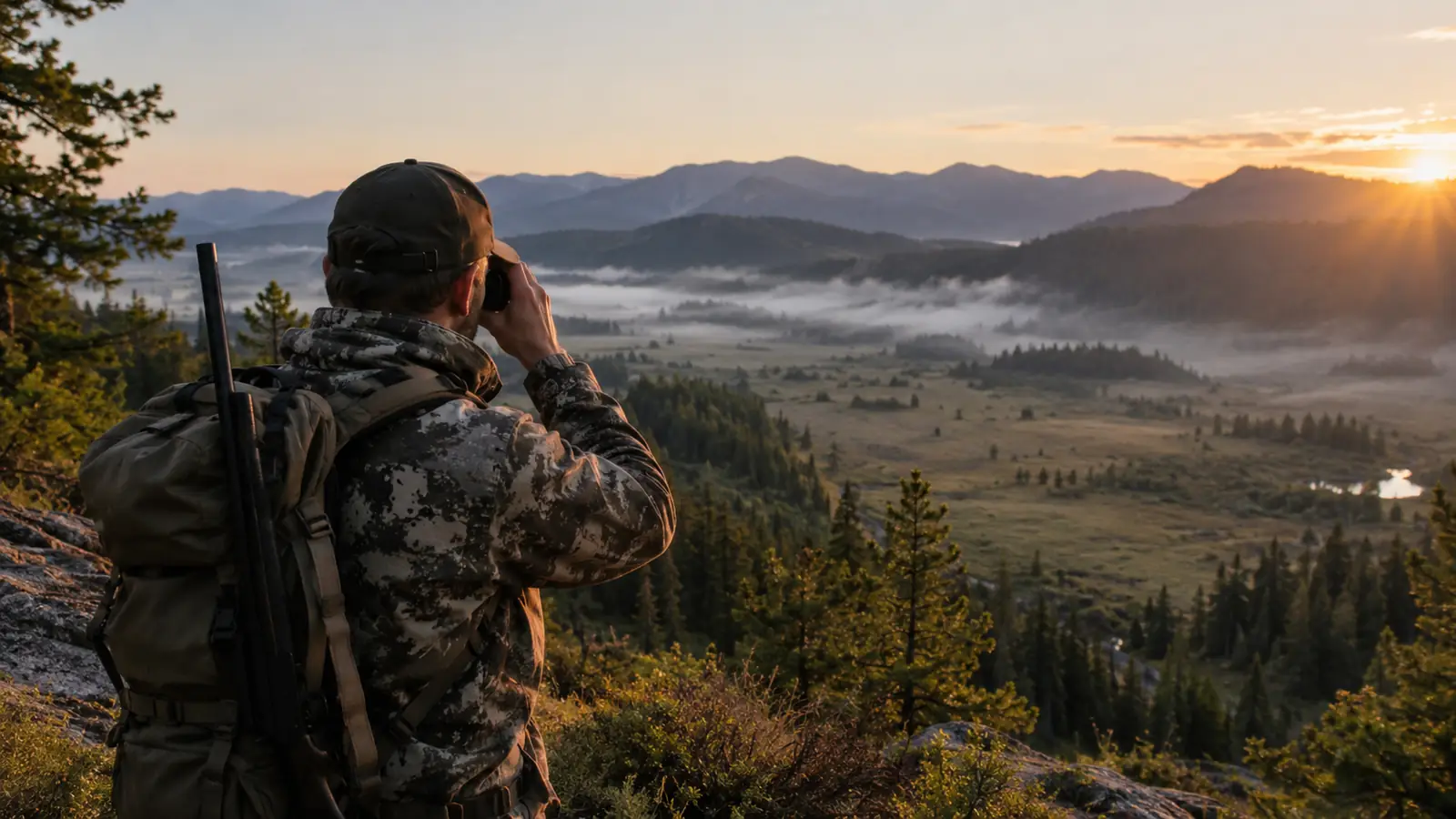
I did not start with a rangefinder. I started with a guess and an eye that is thirty years older, and I can show you the spots where that guess cost me a shot. On an October morning above the Ogden River, I ranged a mule deer buck at 317 yards. The TIDEWE rangefinder gave me that number in about a second. Before I owned one, I would have called it 275 and held for 275. That is the whole point of learning to range the right way.
Ranging sounds like the easy part of hunting. It is not the hard part, but it is the part that needs the least thinking and the most repetition. The cold feeling in my chest comes from guessing wrong at distance, not from deciding whether to shoot. An elk can stand in an opening for a minute. A mule deer can sidestep into dark timber in less time than that. You need more than one reading, and you need it before the animal moves. Two seconds spent checking now can save a two-mile pack-out in the dark.
Range your next animal with a tool you can trust
I keep the TIDEWE Hunting Rangefinder in my pack because it is rechargeable, easy to read in low light, and simple enough that I do not think about it while an animal is in front of me.
Amazon Check Today's Price on Amazon →Step 1: Brace yourself the way you would for a shot
Press the button from wherever you happen to stand and the TIDEWE will often still give you a number. The number may be the tree behind the animal, the ground in front of it, or a limb hanging between. When I teach a new hunter, I start in an empty field with a row of fence posts. There is no adrenaline, no animal moving, and no wind, so there is nothing to hide a shaky hold. A rangefinder is an honest instrument: it measures whatever sits in the center of its beam. If you are wobbling, that center drifts.
So I brace myself exactly as I would for a shot. I bring the unit up, touch it to my cheekbone, tuck my elbow against my ribs, and if I have the chance I lean into a tree trunk or set my forearm across a knee. Last October I spent an afternoon on a ridge above Ogden ranging fence posts between 200 and 600 yards. Standing, my readings bounced around by eight to ten yards. Braced, the same posts settled into numbers I could repeat. That afternoon taught me that the button is the last thing I press, never the first thing I use.
The test is not whether you get a reading. It is whether you get the same reading twice. I range a post, lower the unit, then range it again. If the two numbers agree within a yard or two, I trust that distance. If they do not, I find a firmer position before I waste time on a live animal. At 180 yards a bad brace might cost you nothing. At 480 yards it can put a clean miss into the book and start a long, cold morning of regret.
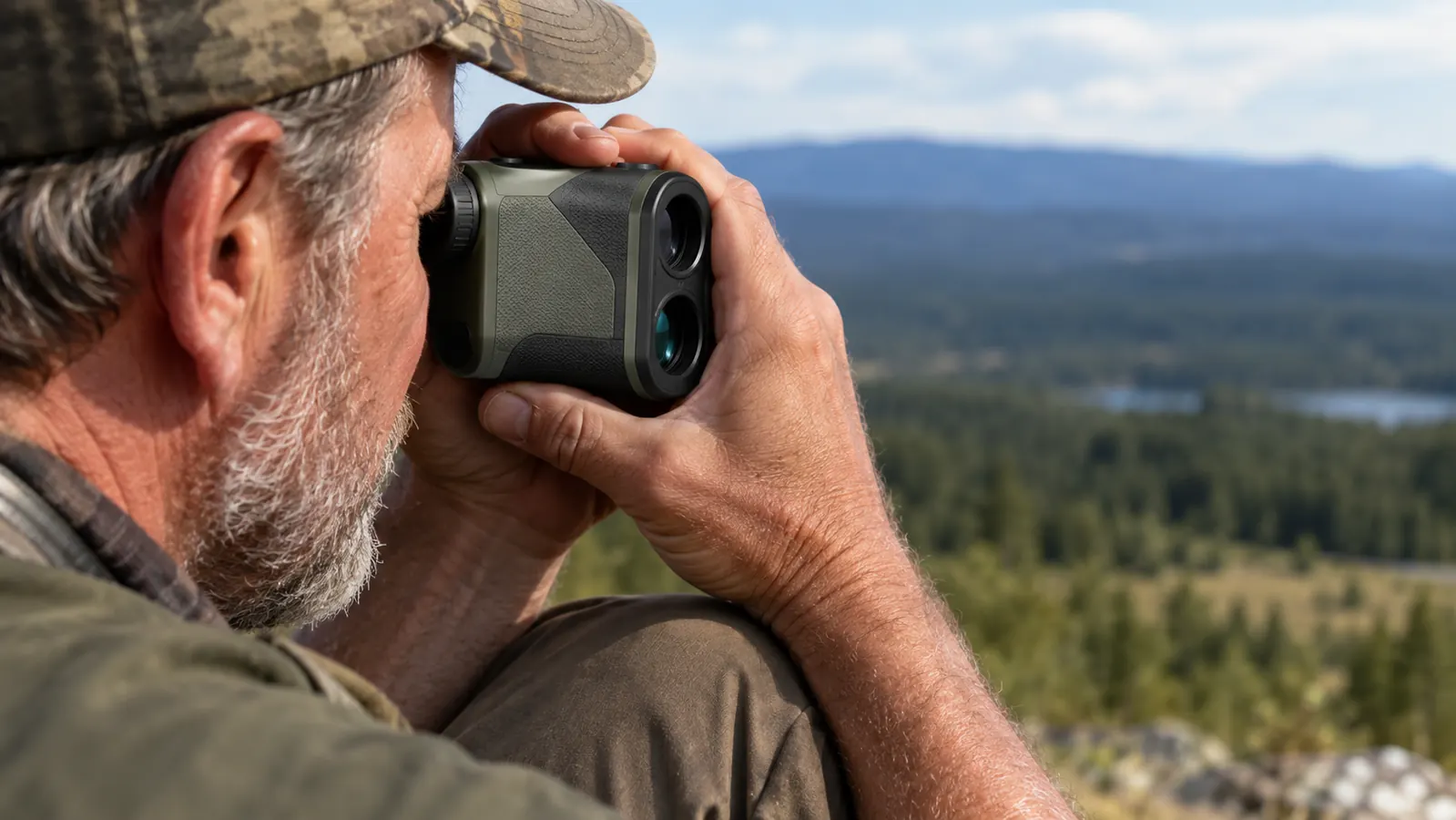
Step 2: Aim at the chest, not the antlers or the brush
The beam that leaves a rangefinder is narrow, but it is not a pencil. It spreads as it goes, and it can also bounce off a snowflake or a patch of fog and give you a number that has nothing to do with the animal. If you center it on antlers, you can catch a limb behind the head or sky beyond the ridge. If you center it on a thin bush beside the animal, the unit may range the hillside behind it. I aim low, at the center of the chest, where solid hide and bone give the beam something dependable to return from.
For an elk, that target is generous. The chest of a mature bull is deep enough that you can be a little sloppy and still get the same number. On a mule deer, the chest is smaller and the margin is thinner. Put the reticle on the front third of the chest, just behind the shoulder. That is where I want the bullet to land anyway, so ranging there aligns the two problems. It also keeps me from aiming too high, which is the easiest way to miss when the animal is feeding downhill.
Practice on a bale of hay or a paper target at 300 yards, and you will see how precise you need to be. Stand behind it and try to range the edge rather than the center. Then range the center. The difference will teach you more than any manual. I did the same exercise from a sitting position and from a kneeling position, because field shots are rarely standing shots. A deer on an open hillside never waits while I get comfortable, so my practice has to match the way I actually hunt.
Step 3: Make sure it says yards when it should
I have watched a good hunter miss a buck because his borrowed rangefinder was set to meters and he never noticed. A display that says 274 instead of 300 changes the hold more than most people think. I check my unit the way I check the windage on a rifle: before I need it. The TIDEWE has a simple readout and the setting is easy to change, so I set it in camp and glance at it again in the dark.
Yards versus meters matters more on elk and deer than on a target at a flat range. A 400-yard elk is 366 meters, and because bullet drop grows faster than distance, that 34-yard difference can be the difference between a clean lung shot and a gut-shot animal. If you try to do that math under pressure after a long stalk, you will get it wrong. Do the checking now, not then. I also dim the display if the unit allows it. A bright screen pressed to my eye costs me the last few minutes of shooting light, and those are often the minutes an old buck finally stands up.
My own habit is to range a fence post before first light every morning of the season. If it reads the distance I already know, I move on. If it is off by two yards, I know there is something to watch. A two-yard error can be a miss at the far end of a canyon, and it is easier to find at a fence post than at an animal. I write the results in a small notebook that lives in my coat pocket. By the third day of the season I can tell you the range of every opening I can see from camp.
Step 4: Think about uphill and downhill before you need to
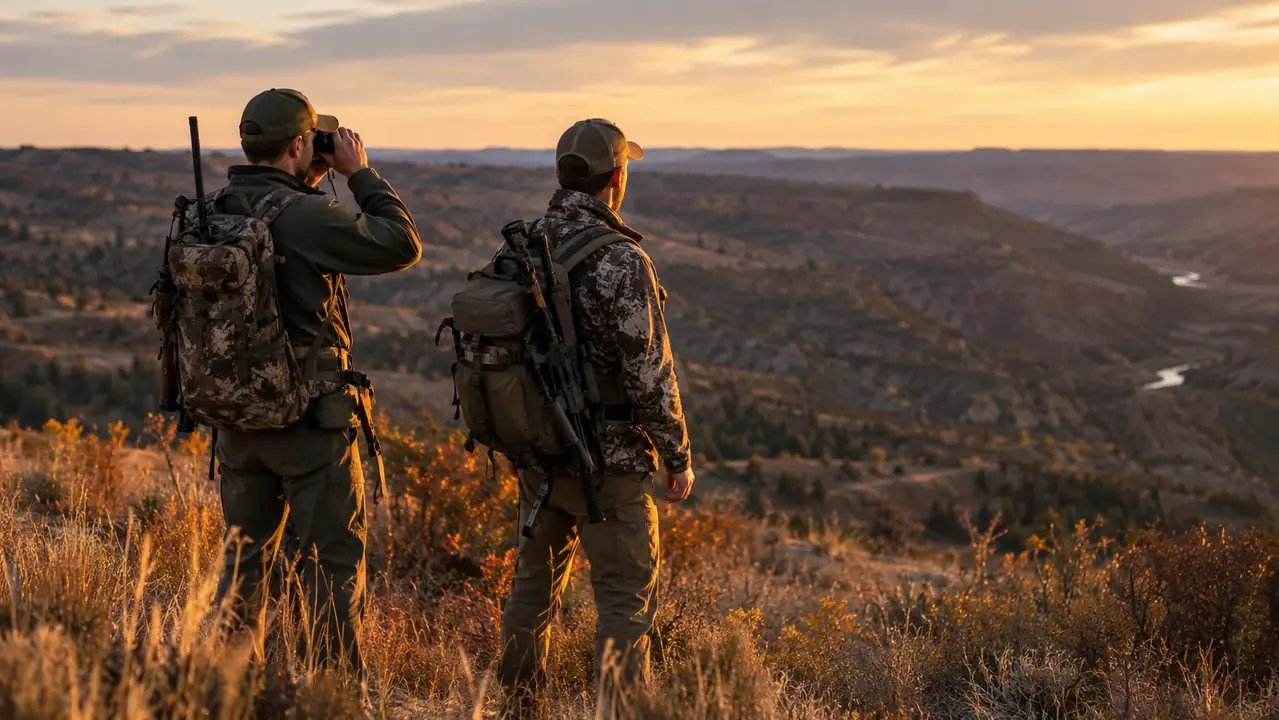
A laser measures the straight line between you and the animal. It does not measure the ground you would walk or the horizontal distance your bullet travels. On flat ground those are nearly the same. On the side of a mountain they are not. A steep 30-degree shot at 300 yards of line-of-sight is closer to 260 yards of horizontal distance, and your bullet drops for somewhere between those numbers. I have watched hunters point at the ridge and say that elk is 400, when the important number for the bullet is closer to 340.
Some rangefinders give you an angle-compensated number. Some do not. The correction matters less inside 250 yards and far more beyond that. What matters most is that you know which kind of number you are looking at. With the TIDEWE, I read the manual once so I know what the screen is telling me before I need to use it in the field. I keep the unit in the same setting for the whole season, and I do not change it in the middle of a hunt when I am cold and tired and likely to make a mistake.
My rule for mountain hunting is simple. If the animal is inside 300 yards and I can find a spot to shoot from that is not a steep downhill angle, I use that spot. If I have to take the steep angle, I range it, practice with my rifle at known distances often, and give the bullet the honest respect it deserves. I would rather wait for the animal to feed into a more level place than rush a shot from a sidehill that looks good in the moment and bad in the retelling.
Step 5: Range the exact path, then range it again
Once an animal is in front of you, no single number should end the conversation. The TIDEWE is fast enough that I can range, lower the unit, and range again before a worried elk moves ten feet. I do that on purpose. The first reading tells me where the animal was. The second tells me whether it is still in the same place. I trust a repeatable number more than a lucky one. If the two readings disagree, something changed, and the animal gets the benefit of the doubt.
Range the lane too, not just the animal. If I plan to shoot through a ten-yard gap between two pines, I want to know that the gap is 315 yards and the animal is 320. The bullet will follow the lane, not a perfect line from my eye. When the numbers do not match, I adjust or wait. Last fall the only elk I did not shoot all season was standing in a hole in the timber, with the nearest lane 40 yards closer than the animal. I watched her feed out of the timber and felt fine about it.
One more thing: keep your ranging and your shooting separate enough that your hands do not argue. I used to range with the same hand I shoot with, and I always wanted to keep my finger near the trigger. Now I range, lower the unit, take a breath, then settle into the rifle. That pause does more for my accuracy than any extra magnification I could name. It also gives the animal time to give me another body position, which tells me whether it is calm enough for a clean shot. If it stomps and stares at the sound, ranging was the easy part and I wait.
What Else Helps
A rangefinder does not replace the rest of the routine. I still shoot my rifle from field positions through the summer, and I still watch the wind. The TIDEWE has become one more honest check before I commit. For elk and deer hunting, I carry it on a short lanyard around my neck under my jacket so it is warm and out of the way, and I zip it inside my coat when the rain starts. A rangefinder that gets fogged or soaked is a paperweight, so keep it dry. I also top off the charge before every trip, not when the display starts to get dim on the mountain.
I carry a separate pair of binoculars for glassing. The binoculars find the animal; the rangefinder tells the truth about the distance. They do different jobs, and I never expect the rangefinder to do the glassing. A spotting scope has its place too, mostly after the animal is down or when I am trying to separate one bull from the herd.
Last October I ranged a mule deer buck at 317 yards, lowered the rangefinder, and squeezed. The range was not a guess. That is what made the difference.
Set up for a season of honest distances
The TIDEWE Hunting Rangefinder is the one I keep in my pack. It is rechargeable, simple to use in the field, and it has held up through two wet autumns.
Amazon Check Today's Price on Amazon →