
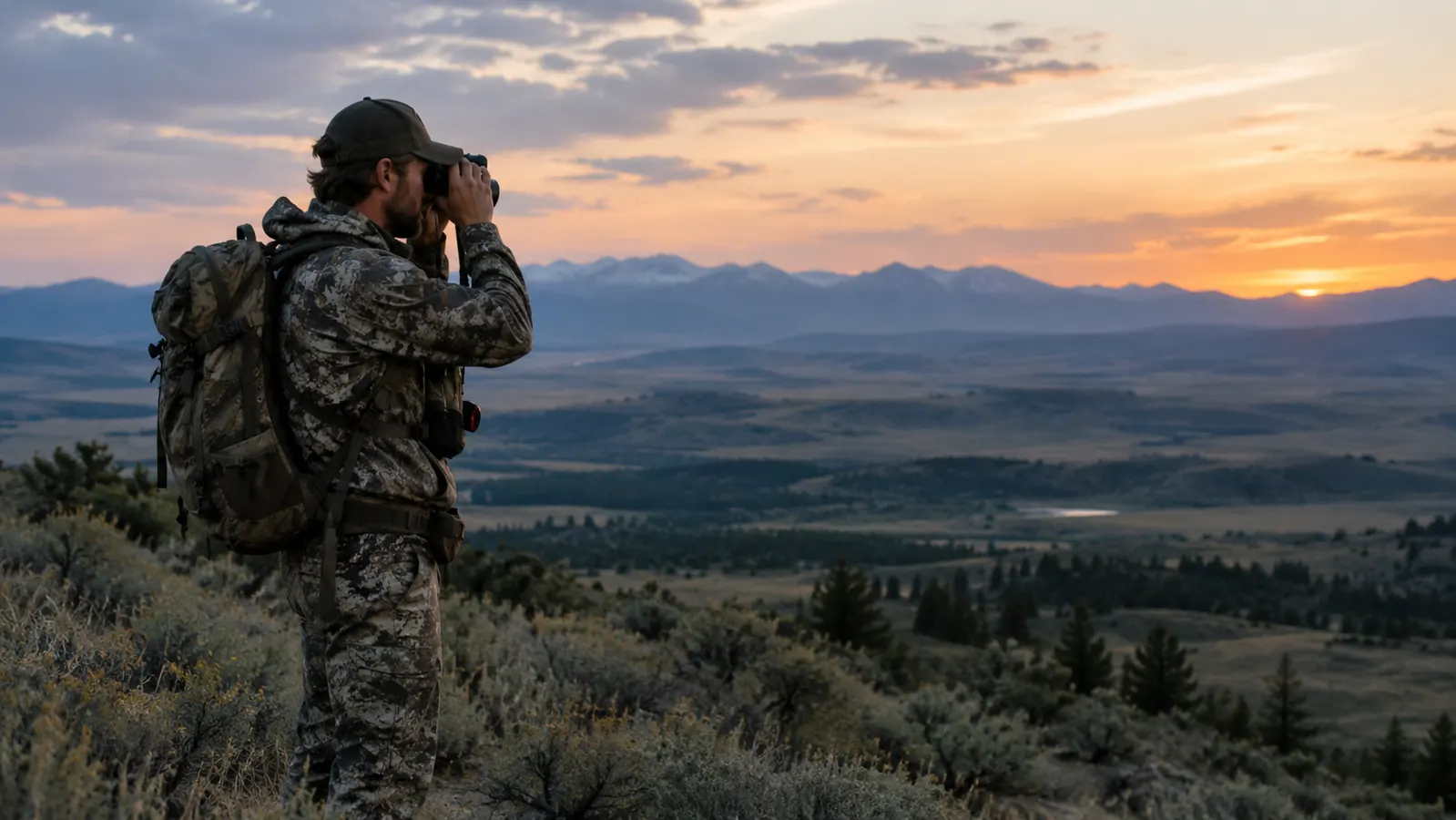
I have carried the TIDEWE rangefinder on every hunt and most fishing trips for two full seasons, and I finally feel ready to write the honest review I could not find before I bought it. Most of what you read about rangefinders online comes from someone who opened the box on a Tuesday, ranged a stop sign, and typed five enthusiastic paragraphs before the battery ever needed a charge. This is not that review. I waited until this rangefinder had been rained on at Willard Bay, dropped on a basalt ridge east of Ogden, and carried through eleven straight days of archery elk hunting in September. I also waited until it had made real decisions easier, because that is the only test that matters.
The short version is that it is a good rangefinder with a few honest flaws, and I am going to tell you about both. If you want the weaknesses laid out before you part with your money, keep reading. If you want a sales pitch, you have come to the wrong page.
The Quick Verdict
Four and a half stars and an 8.5 out of 10 after two seasons. It reads true, holds a charge, and has never let me down when an animal was in front of me. It also falls asleep too fast, has stiff buttons in the cold, and washes out in bright snow. Buy it with your eyes open.
Amazon Check Today's Price →The honest version is coming. Here is the short one.
The TIDEWE reads fast, reads true, and has survived two seasons of real use. If you want a rangefinder without the premium name, this is the one I reach for on September mornings.
Amazon Check Today's Price on Amazon →How I Have Used It
I am Emmett Prosser, a retired heavy equipment mechanic, 58 years old, living north of Ogden with a chocolate Lab named Ruby and a 2016 Tundra that is pushing 190,000 miles. Everything I own has to survive being thrown into that truck bed, and this rangefinder has been thrown in plenty of times. Ruby is steady in a boat and hopeless in a ground blind, so she rides along for trout on the Weber and bass at Willard Bay, and she stays home when the elk and deer hunts roll around.
My seasons run archery elk in September, rifle mule deer in October, ice fishing at Pineview in January, and trout from April until the rivers blow out in the spring runoff. That means this rangefinder has gone from warm September afternoons at 8,500 feet to subzero January mornings on the ice, with foggy river bottoms in between. It has seen the full swing of a Utah year, and that is the kind of exposure that finds weaknesses fast.
In a typical October week I range deer dozens of times a day, even when I already know the distance, because I want to see whether the numbers stay consistent shot after shot. By the end of rifle season I had put hundreds of readings through it. I also use it on a steel target at a gravel pit up past Pineview, from about 300 out to 500 yards, to make sure it agrees with distances I have measured on the ground. Repetition is what ruins cheap optics, and this one never stopped agreeing.
What It Does Well That the Listing Won't Tell You
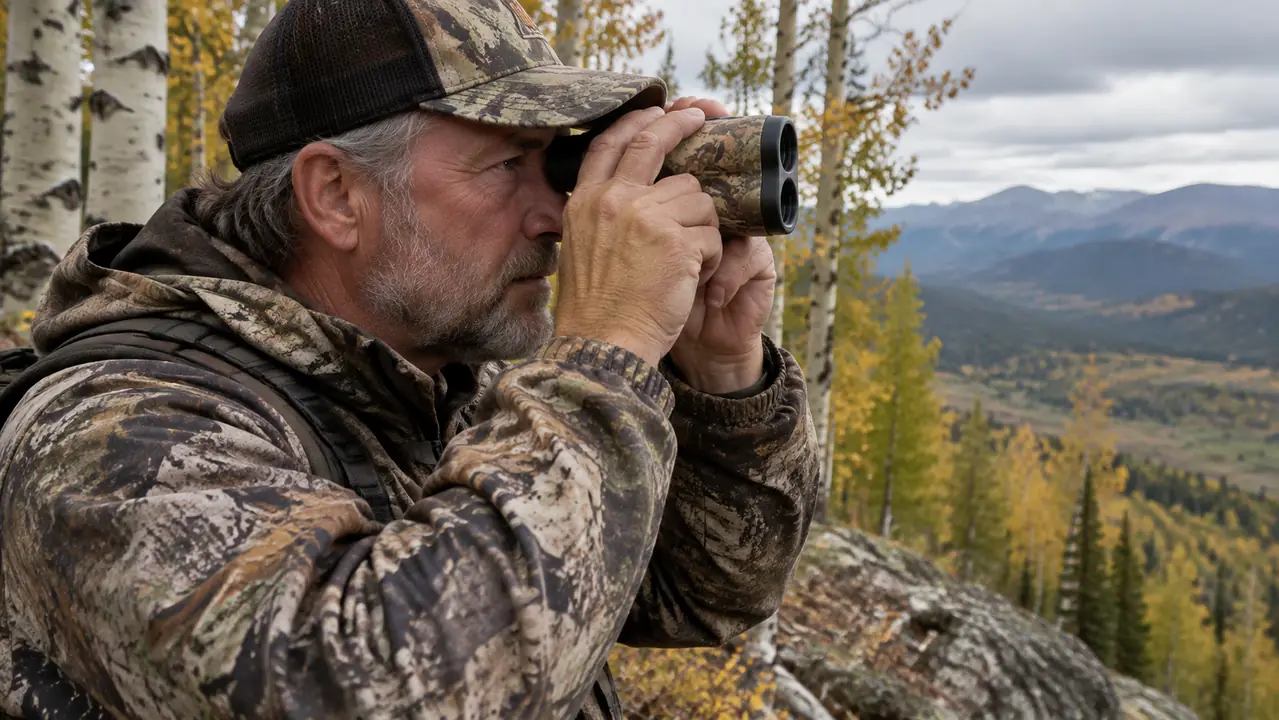
The first surprise is the glass. For a budget rangefinder I expected usable but dim optics, the kind that go gray in low light. Instead, in the last fifteen minutes of shooting light, the time when mule deer actually move, the view stays clear enough to pick out a buck bedded in the sage and read the display without squinting. That is exactly where cheap rangefinders give themselves away, and this one does not.
The second thing is consistency, which is the whole job. A rangefinder that says 310 yards one day and 330 the next is worse than none at all, because it makes you second-guess every setup. On the third evening of archery season I ranged the same bull elk three times from the same rock: 87, 88, and 88 yards. A one yard wobble is nothing. The next morning I ranged a different bull at 62 yards and made the stalk count. That is the trust you are actually paying for.
The third thing is speed. When a buck is crossing a saddle you get one chance, not three. I press the button and have a number in about a second, and it reads a standing animal on the first try more often than not. I aim at the center of the chest rather than the antlers, because every rangefinder will grab the first thing in its beam if you give it the chance.
I have also pushed it further than I would ever shoot at an animal. On the gravel pit target I range the steel plate at 500 yards and it reads honestly out there, and it reads the dirt berm behind it at 520 without hesitation. That is further than any shot I would take on public land, so the range capability has never been the limit. The glass and the consistency have always been the limit on cheaper units, and neither one has held this one back.
The Honest Problems Nobody Puts in the Description
Now the part the TIDEWE listing leaves out. None of these flaws have made me want to send it back, but they are real, and you deserve to hear them from somebody who has lived with them.
The auto shutoff is the one that gets under my skin. The rangefinder puts itself to sleep after roughly eight seconds of sitting still. That would be fine if I did not glass first with binoculars, then pick up the rangefinder for the distance. By the time I have it to my eye, it is asleep, and I have to press the button, wait for the display to wake, and range the same spot twice. On a calm evening that costs me two seconds. On a buck that is about to step over the ridge, it is the longest two seconds of the whole season. I have learned to keep my thumb on the button until I see the number.
The buttons are the second thing, and this one is physical, not electronic. They are small and need a firm press, which suits a September morning and fights you in late October when you are wearing glove liners with cold fingers. More than once I pressed, felt nothing, glanced down at the unit, and pressed again. A rangefinder that makes you take your eye off the animal is not doing its job yet. The fix I settled on is to press slowly and hold for half a second, and it works. But you should not have to invent a workaround for a button.
The next problem only shows up when you need it least. On a bright afternoon with snow on the ground, the display numbers wash out against the glare and I lose the reading for a second. Shading the objective with my hand brings it back. It is manageable, and it is also absolutely real, and I would rather tell you now than have you discover it on the first snow of the season.
Rain is a mixed report. The body has been soaked at Willard Bay and wiped down wet after a wet November hunt, and the electronics never blinked. But a drop of water on the objective lens turns the image milky until you wipe it off, and on drizzly mornings I wipe the lens more often than I range. Keep a microfiber cloth in your chest pouch. You will use it more than you expect.
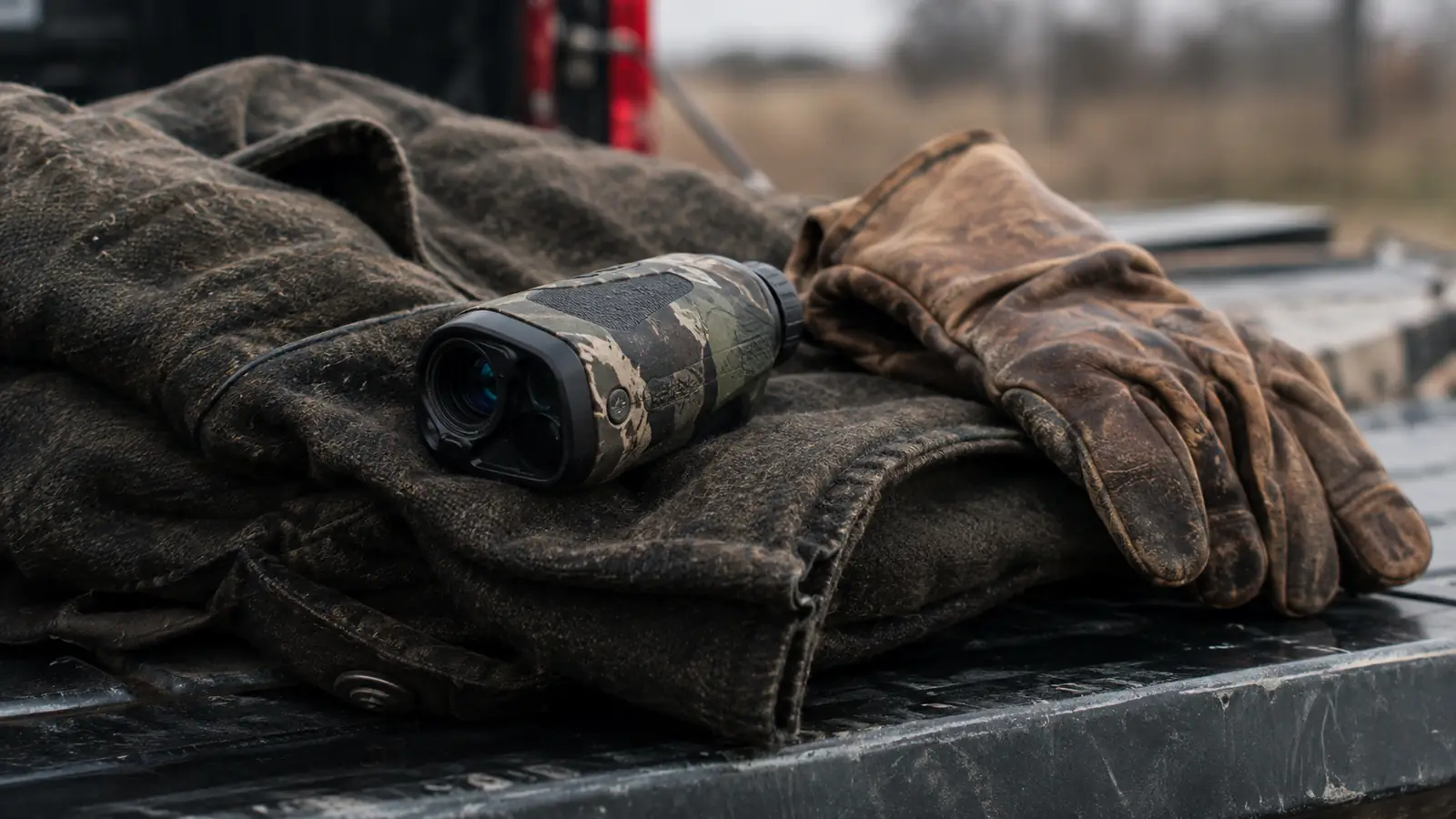
Last, the camo finish wears like honest gear. Two seasons of rubbing against basalt and bouncing in the truck bed have left scuffs along the corners, and you can see them if you look. It is cosmetic only, and the rangefinder works exactly as well as the day I unpacked it. But if you are the kind of hunter who keeps his gear looking new, know that this is a working tool, not a safe queen.
The Rechargeable Battery Question
I will be straight with you: I did not want a rechargeable rangefinder. Every rangefinder I had owned before this ran on CR2 batteries, and I kept spares in the glove box out of habit. The rechargeable battery has changed my mind, mostly. I charged it at the kitchen counter on a Sunday in late August, used it for evening practice three nights a week through September and October, and did not plug it in again until mid-November. That is more than two months of honest use on one charge.
The one warning is cold weather. On the coldest mornings the battery indicator dropped a bar by mid-morning, and that made me nervous on a hunt a long way from the truck. It never actually died on me, but I could see the chemistry slowing down. Now I toss the charging cable into the center console before October and I do not think about it again. If you are the kind of hunter who spends two weeks in the backcountry with no power, that is a real consideration, and you should weigh it before you buy.
For my kind of hunting it is a fair trade. I used to carry spare CR2s and wonder whether the battery in the rangefinder was getting weak as the season wore on. Now I charge this with the same cable I use for my headlamp, I know exactly where the charge stands, and I never search for a specialty battery at a gas station on opening morning.
How It Stacks Up Against What I Used Before
I have owned a Bushnell for years, and I borrowed a friend's Vortex on a hunt in Idaho, so I have a baseline for what the extra money buys. The TIDEWE will not beat the Vortex in low light, and it does not carry the same warranty reputation. But for the way I actually hunt, which is inside 500 yards on public land a couple hours from the house, it gives me the same number at the end of the day, and it gives it to me faster than my old Bushnell did.
The honest differences are small. The Vortex is lighter in the hand and its buttons click with authority, where the TIDEWE buttons feel soft. The Bushnell had coatings that shed rain better, though its battery door was always the part that worried me. On the features that matter for my hunting, the distance reading and the trust I put in it, the TIDEWE matches both of them.
If money were no object I would probably be carrying the bigger name, and I am not going to pretend otherwise. What I will tell you is that the rangefinder that gets used is the one you can afford to replace the day you drop it off a cliff, and I have dropped this one on rocks twice. It is still here, still reading true, and still the first thing I grab on opening morning.
What I Liked
- Glass stays clear and usable in the last minutes of legal shooting light
- Consistent readings, ranging the same target within a yard or two every time
- Battery lasted more than two months of regular hunting and practice on one charge
- Body has handled rain, cold, and drops on rock without a failure
- Simple controls with no menu, no pairing, and nothing to configure
- Charges with a common cable instead of a specialty battery
Where It Falls Short
- Shuts off after a few seconds and costs you time when you pick it up to range
- Buttons are stiff with cold hands and glove liners
- Display can wash out against bright snow until you shade it
- Camo finish scuffs and shows wear quickly, purely cosmetic
It ranged the same bull elk at 87, 88, and 88 yards. Consistency is the whole job, and this one does it.
Who This Is For
Buy the TIDEWE if you are a hunter who takes most of your shots inside 500 yards and wants a rangefinder that can live in the truck, get thrown on the passenger seat, and still read true on the first cold morning of rifle season. It is built for the public land hunter who would rather spend the extra money on gas to scout new country than on a name printed on the side of an optic.
It is also a fair companion for the fishing side of my life, because it does not care whether it is banging around in a tackle bag or a pack. If you are the kind of person who checks the battery the night before opening day and wants one less thing to worry about at 5 a.m., this rangefinder suits you. It is a tool, and it acts like one.
Who Should Skip It
Skip it if you are a serious long range shooter who needs dependable numbers past 700 yards at first light, because that is a different category of optic and this is not the tool for that job. Skip it if you buy gear for the warranty and the service department behind the name, because the big optics companies earn their reputations there. And skip it if a short auto shutoff would drive you crazy, because that behavior is not going to change.
I will also say something that will not sell any rangefinders: if you hunt one fixed stand over a 40 yard food plot and you already know every distance by heart, you do not need this. Spend the money on ammunition and range time instead. That is the honest answer, and it is the reason you should trust the rest of what I just told you.
The honest verdict after two seasons and hundreds of readings:
The TIDEWE reads true, charges with a cable I already own, and has survived the kind of use that ends cheaper gear. If you want a no-nonsense rangefinder without the premium name, this is the one I keep reaching for.
Amazon Check Today's Price on Amazon →